

Blog
How Is CPF Calculated in Singapore

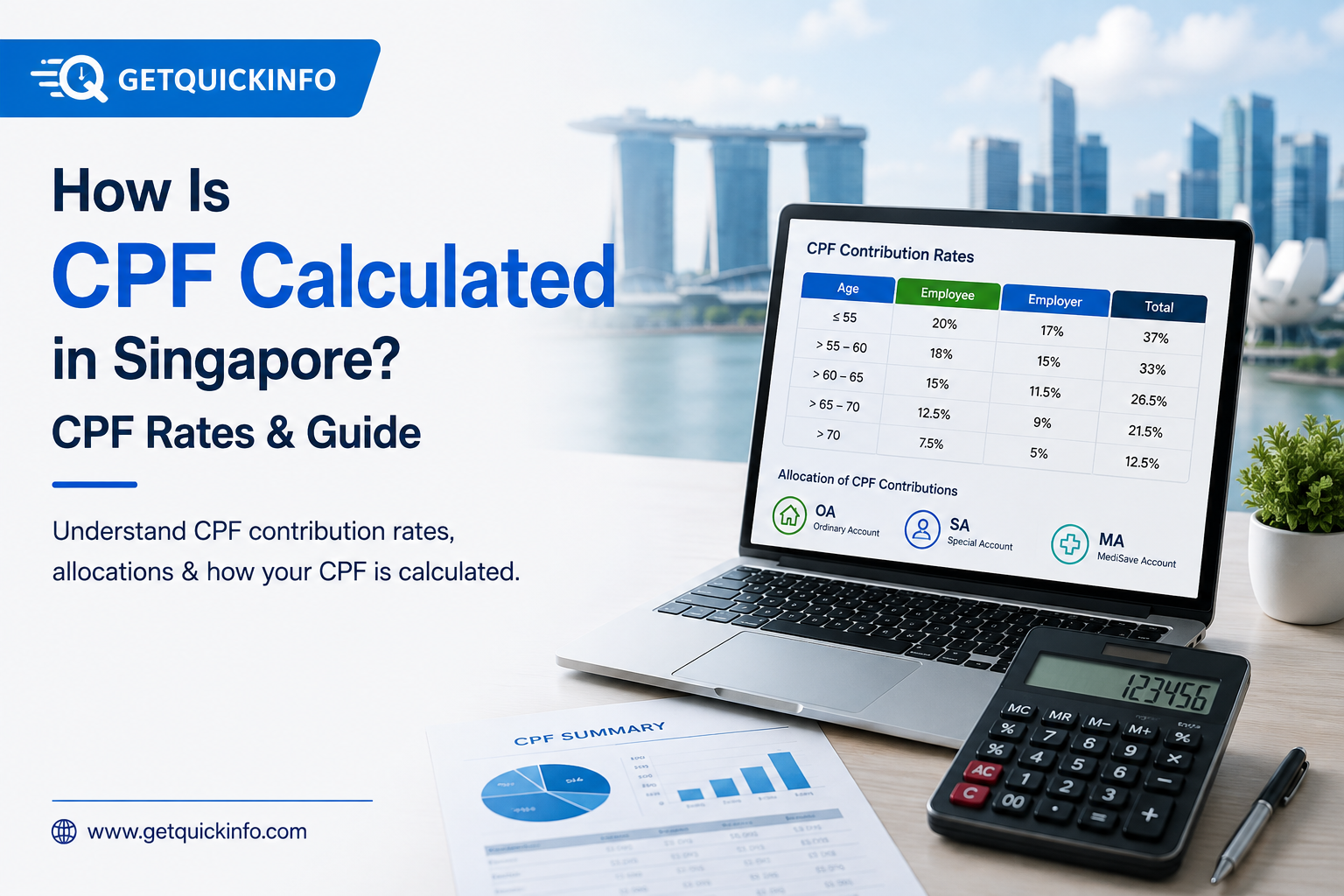
Here's the short answer: CPF is calculated by taking your CPF-applicable wages and multiplying them by a contribution rate, then splitting that amount between you and your employer. But the rate you actually fall under isn't the same for everyone. It depends on a handful of things that are unique to you:
- Your age — contribution rates drop in stages as you get older
- Your CPF-applicable wages — this means your Ordinary Wages and Additional Wages, both of which have their own ceilings
- Your citizenship or PR status — new Permanent Residents get lower, graduated rates for their first two years
- Your employee contribution rate — the portion deducted straight from your pay
- Your employer contribution rate — the portion your company adds on top
Because these factors mix differently for everyone, two colleagues earning the same salary can still walk away with different CPF numbers each month.If you don't want to sit down and work it out by hand, our GetQuickInfo CPF Calculator will give you a quick estimate in seconds.
The Basic CPF Calculation Explained
Once you strip away the jargon, CPF math really comes down to two multiplications and one addition. Your share is your applicable wages multiplied by your contribution rate. Your employer's share is the same wages multiplied by their own rate. Add the two together, and that's your total monthly CPF contribution.
Employee CPF = Applicable Wages × Employee Contribution Rate
Employer CPF = Applicable Wages × Employer Contribution Rate
Total CPF = Employee CPF + Employer CPF
The tricky part isn't the formula itself it's that the CPF contribution rates behind it aren't fixed. They change depending on your age and how much you earn, which is where things get a little more interesting.
CPF Contribution vs CPF Allocation
These two words get used a lot interchangeably, but they're not actually the same thing. Contribution is simply the total amount going into your CPF each month it's the number you get from the formula above. Allocation is what happens afterwards: how that same amount gets divided across your three CPF accounts Ordinary Account (OA), Special Account (SA), and MediSave Account (MA).
Put simply, contribution tells you "how much," and allocation tells you "where it lands." That's why two people contributing the same dollar amount can end up with very different account balances their allocation ratios shift with age, even if the total is identical. Once you understand both sides, your CPF statement makes a lot more sense.
How Age Changes CPF Contributions
CPF rates aren't one flat number they're broken into age bands, and each band carries its own combined rate. Generally, the older you get, the lower your total contribution rate becomes, though your employer's and your own share don't always move at the same pace. Here's how it currently looks for anyone earning above $750 a month (Singapore Citizens and PRs from their third year onward):
|
Age Band |
Employer |
Employee |
Total |
|
55 and below |
17% |
20% |
37% |
|
Above 55 to 60 |
16% |
18% |
34% |
|
Above 60 to 65 |
12.5% |
12.5% |
25% |
|
Above 65 to 70 |
9% |
7.5% |
16.5% |
|
Above 70 |
7.5% |
5% |
12.5% |
One thing worth remembering: your rate doesn't change the day you turn 55, 60, 65, or 70 — it only kicks in from the first day of the following month. Small detail, but it trips up many payroll calculations.
How Salary Affects CPF Contributions
Not all of your income gets treated the same way under CPF. Your regular monthly salary usually counts as Ordinary Wages (OW), which is capped at $8,000 a month. Bonuses and other one-off payments fall under Additional Wages (AW) instead, calculated separately against an annual ceiling of $102,000 minus whatever OW has already been subject to CPF that year.
This is exactly why your full gross salary doesn't always get the same treatment. If you're earning $10,000 a month, for example, CPF only applies to the first $8,000 the remaining $2,000 sits outside the calculation entirely.
What Happens to the CPF Contribution After It Is Calculated?
Once your contribution is worked out, it doesn't just sit in one account. It gets automatically split three ways into your Ordinary Account (for housing and investments), your Special Account (for long-term retirement savings), and your MediSave Account (for healthcare costs). How much goes where depends on your age, with older employees typically seeing a bigger chunk directed toward MediSave and retirement savings. This is really the step that turns a single monthly number into the long-term savings CPF is actually built for.
Common CPF Calculation Mistakes
Even a formula this simple can go wrong if the inputs are off. Some of the mistakes we see most often:
- Using the wrong age bracket — especially right after an employee's birthday, when the new rate hasn't kicked in yet
- Mixing up employee and employer contributions — which throws off take-home pay estimates
- Ignoring wage ceilings — and applying the rate to the full salary instead of just the capped portion
- Assuming everyone's rate is the same — when age, wages, and residency status all pull it in different directions
- Confusing contribution with allocation — treating the total amount paid as the same thing as how it's split across accounts
Catching these early can save both employees and employers a fair bit of back-and-forth payroll correction later on.
Calculate Your CPF Contribution
Honestly, you don't need to sit and work through age bands, wage ceilings, and allocation rules on your own that's what we built this for. Our Getquickinfo takes your age, salary, and residency status and gives you your exact employee, employer, and total CPF contribution in seconds, so you always know exactly where you stand.